


_edited.png)
Letting Go With Love: Why Emotional Attachments Make Decluttering So Hard (and How to Start)
Updated: Dec 16, 2025

If you’ve ever stood in the middle of a room, completely overwhelmed, holding a sweater that belonged to your mom or a stack of your kids’ drawings… and thought,
“If I get rid of this, am I a bad daughter? A bad mom? Will I forget them?”
…you’re not broken. You’re human. ❤️
As a professional organizer, I see this all the time. My clients don’t just struggle with “stuff”, they struggle with what the stuff represents: memories, love, identity, safety, a season of life they’re afraid to lose.
I recently sat down with my friend Kate Fish, a therapist and owner of Graceful Therapy, to talk about why letting go is so emotional and how we can do it more gently, without shame. This blog is born out of that conversation.
If you’ve been feeling stuck in your home, this one’s for you. -Nichole
Why We Get Emotionally Attached to Our Things
Kate shared something that hit me hard:
Sometimes we attach to things because we didn’t get consistent, safe attachment from people.
Maybe there was:
Childhood trauma
Unreliable caregivers
A sense that people weren’t safe or consistent
So our brain learns:
“People leave. Things stay. Things feel safer.”
Objects start to feel like stability and forever in a world that feels unpredictable.
The tricky part? Nothing is truly permanent. Life, circumstances, people, even houses – they all change. When we cling tightly to things to try to stop that reality, we actually cause ourselves more suffering. We’re fighting the truth that life moves, shifts, and evolves.
And yet… that doesn’t mean you’re “wrong” to feel attached. It just means your brain is trying to protect you in the only way it knows how. This is why emotional attachments make decluttering so hard.
Grief, Loss, and Keeping “All of Mom’s Things”
One very common situation I see is a daughter who has lost her mom and is now keeping:
Every piece of clothing
The perfume
Gifts
Any object that holds a memory
It feels like:
“If I let any of this go, I’m letting her go.”
Kate’s take? You’re trying to hold on to something intangible (your relationship, your mom’s love, your memories) by clinging to something tangible (her belongings).
The truth is:
You can still remember your mom and honor her,
Even if you don’t keep every single item.
You don’t have to live in an “all or nothing” world:
Keep everything and feel suffocated or
Get rid of everything and feel panicked
There’s a gentle middle.
You might keep:
One or two deeply meaningful pieces of clothing,
A piece of jewelry,
A handwritten recipe,
…and let the rest go, trusting that your memories live in you, not just in your things.
A question Kate suggested that you can ask yourself:
“What am I afraid will happen if I let some of these things go?”
Name the fear. Then reality-check it a bit:
“Would I really forget my mom if I kept 2 things instead of 10? Would our relationship actually disappear?”
The Lies Our Brain Tells Us About Stuff
There are a few very common thoughts that keep people stuck in clutter:
“What if I need it someday?”
“A good mom keeps everything her kids make.”
“If I let this go, I’m ungrateful.”
“If I get rid of her things, I’m letting her go.”
These are what therapists call cognitive distortions, thoughts that feel true, but aren’t actually accurate or helpful.
Here are some gentler truths you can try on:
You are still a good mom even if you don’t keep every scribble and broken toy.
You are still a loving daughter even if you donate some of your mom’s belongings.
You are still capable and resourceful even if you no longer own every “just in case” item.
In fact, you might be able to show up as an even better mom, daughter, partner, and friend when you’re less overwhelmed by your home.
A helpful reframe:
“Is the value in this thing, or in the space, peace, and time I gain by letting it go?”
Why Clutter Makes You So Stressed (It’s Not Just You Being “Bad at This”)
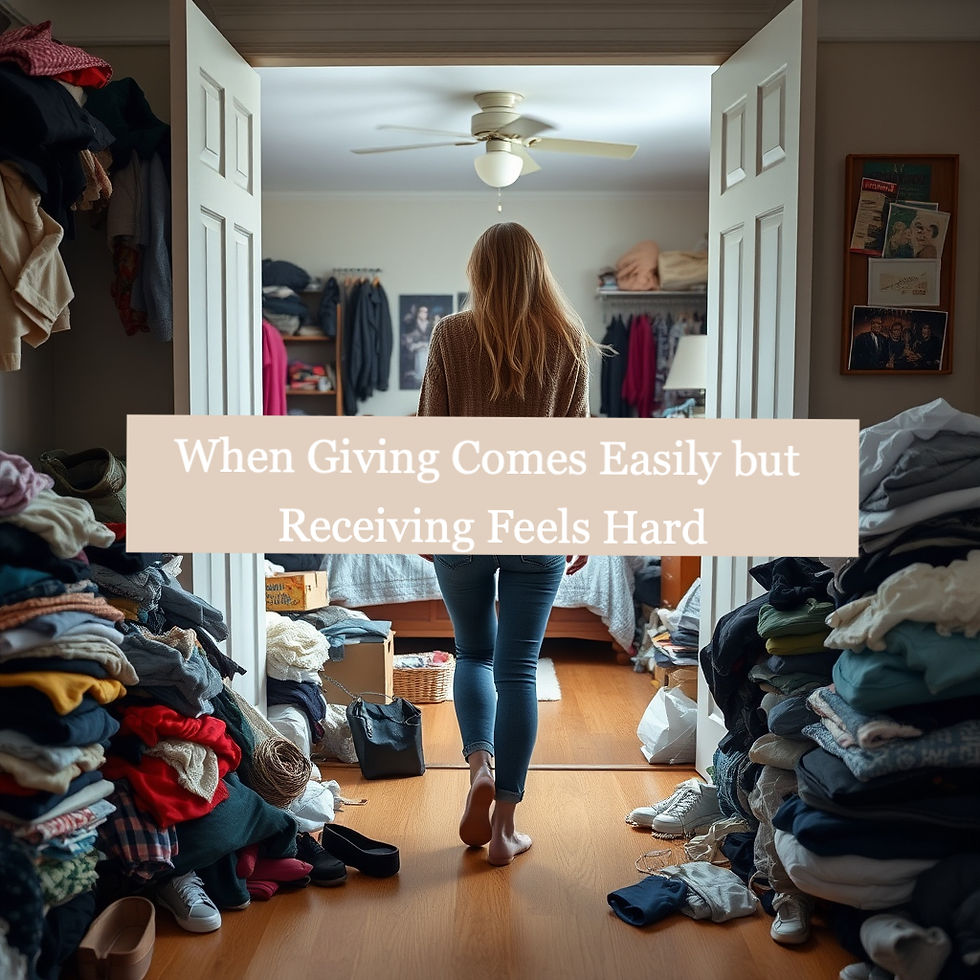
If your home feels visually loud – piles, stacks, bags, colors, random things everywhere – your nervous system is doing a lot of work just existing in that space.
Kate explained that when you’re overstimulated visually and mentally, your brain can slip into fight-or-flight mode. In that state, the part of your brain that makes good, calm decisions (your prefrontal cortex) is harder to access.
It’s like trying to make life decisions in a Chuck E. Cheese. 🎟️
You wouldn’t schedule a serious business meeting in an arcade. The noise, the chaos, the blinking lights – your brain is too overstimulated to think straight.
The same thing happens in a cluttered room. It’s not that you’re lazy or unmotivated; your brain is simply overwhelmed. Of course decision-making feels hard.
So no, you’re not “bad at organizing.” You’re trying to think clearly in what feels like a mental arcade.
How to Recognize When You’re Emotionally Attached to an Item
Here are some red flags that an item may hold emotional weight:
You feel anxious or panicky at the idea of letting it go.
You feel “naked” or unsafe without it.
You don’t want anyone else using, touching, or moving it.
Your attachment to the item is blocking your goals for the space (no room to play with kids, host, relax, work, etc.).
You can ask yourself:
“What do I want this room to feel like?”
“What do I want my kids to feel when they’re in here?”
“Is my attachment to this stuff helping or hurting that?”
If your attachment is keeping you from functioning well in the space, it’s not that you’re bad or broken – it just means something needs attention and gentleness.
A Gentle First Step: Visualize Your “After”
If you’re overwhelmed and don’t know where to start, Kate recommends starting with visualization instead of trash bags.
Pick one room and ask:
“How do I want to feel in this space?”
“What do I want to be able to do here?”
“How do I want my family to feel in this room?”
It could sound like:
“I want to sit on the floor and play a board game with my kids without stepping over stuff". "I want to host friends without feeling embarrassed". "I want to sit on the couch at night and actually relax.”
You can:
Create a Pinterest board of rooms that make you feel calm and inspired.
Screenshot or print one favourite image and keep it where you can see it.
That vision becomes your anchor. Every time letting go feels scary, you return to:
“This is why I’m doing this. I want that feeling.”
Practical Ways to Gently Let Go
Here are some therapist-approved, organizer-approved steps you can try:
1. Photo First, Then Release
Take a photo of the item that feels too emotional to let go of – kids’ artwork, a sentimental object, etc. Create a “Memories” album on your phone.
You’re not erasing the memory; you’re freeing your space.
2. Reverse “Exposure Therapy” for Your Stuff
Instead of trying to go from “in my hand” to “donated” in five seconds, break it into steps:
Move the item to another room.
Then to a closet or garage.
Then to a bag in your car.
Then to the donation center.
Each step lets your nervous system adjust. You’re gently teaching your brain:
“I’m okay, even when this isn’t right next to me.”
3. Work in Tiny, Kind Sessions
If you are deeply attached to things, a 4–6 hour marathon can be emotionally exhausting.
Try:
10–20 minute sessions
One small category or corner at a time
Pairing each session with something you enjoy (music you love, a favorite podcast, an audiobook)
You don’t have to clear your whole house in a weekend. You just have to move one small pocket at a time toward the life you want.
Building Confidence in Your Decluttering Decisions
Confidence doesn’t magically appear before you start – it grows as you take small actions and survive them.
Two ways to help:
1. Notice How You Feel After You Declutter
At the end of a session, pause and ask:
“How does my body feel right now?”
“Do I feel a little lighter? A little more proud? Can I breathe easier?”
Really let that feeling sink into your body. The next time starting feels scary, you can remind yourself:
“I remember how good it felt last time I pushed through.”
Just like working out – we don’t always want to start, but we rarely regret finishing.
2. Reward Yourself (Without More Clutter 😉)
You can:
Enjoy a quiet coffee alone after a session
Take a bath
Get a pedicure you already planned but intentionally put right after organizing
Or simply give yourself the gift of guilt-free rest:
“I did something hard for Future Me today. I get to sit down now without feeling guilty.”
Daily & Weekly “Reset” Habits That Keep Clutter from Sneaking Back
I often tell my clients:
“Before you ‘earn the right’ to sink into the couch at the end of the day, give yourself a 10–15 minute reset.”
That doesn’t mean perfection. It means:
Putting things back in their homes
Clearing the hotspots (kitchen counter, couch, entryway)
Resetting the room to “calm enough,” not “Pinterest perfect”
From Kate’s perspective, these small routines:
Reinforce that good feeling of completion
Help you start the next day fresh
Prevent that “start from zero” dread every time
You can even:
Take a picture of the room when it’s reset
Use that as motivation: “I want it to feel like this again.”
The Emotional Payoff: What Freedom Actually Feels Like
When people finally start letting go of the excess, Kate notices:
Less mental noise
Less anxiety and overwhelm
More creativity, play, and presence
More ability to move freely, think clearly, and function at a higher level
We often tell ourselves the lie that:
“Having all this stuff around me makes me safer, better prepared, more comfortable.”
But the truth?
Your brain actually craves simplicity. Blank surfaces. Clear floors. Breathing room. Space to think, move, and just be.
When You’re Not Quite Ready (And Why That’s Okay)
Some people are simply not ready to let go yet. As hard as that is for me to see inside a home, and for therapists like Kate to see inside the mind, it’s reality.
In those cases, what we can do is:
Plant a seed
Offer a different way of thinking
Show what’s possible
Release the pressure to “fix it” today
As Kate said, you and I can only do what we can do. The rest is in God’s hands and in the timing of that person’s heart.
You Don’t Have to Do This Alone
If this resonated with you, please hear me:
You are not lazy. You are not broken. You’re just carrying a lot, emotionally and physically.
At Organize By Designe, we come alongside you with both practical systems and emotional safety. We ask about your goals, your “why,” and the life you want in your home, and then we gently work toward it together.
If you’re tired of feeling stuck and you’re ready for some support, I’d love to talk.
Schedule a call with me and get a value virtual
Cheers to getting organized, and letting go with love. -Nichole 💛


Comments